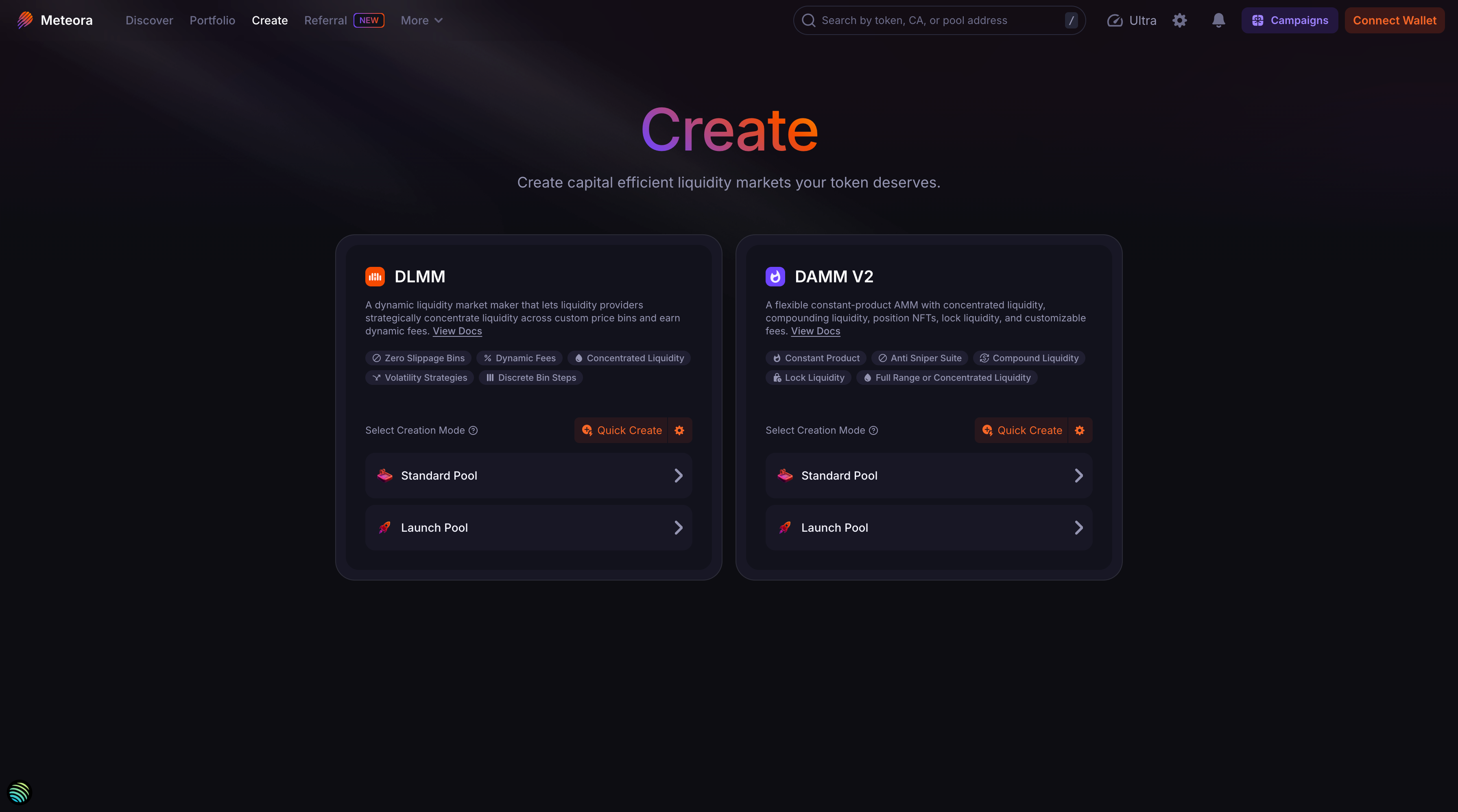
Solana’s rise in decentralized finance (DeFi) has been driven by one core promise: high-speed transactions with low fees. For traders and liquidity providers, that combination changes what’s practical—more frequent trading, tighter arbitrage loops, and smoother user experiences than many slower networks. But performance alone doesn’t build an ecosystem. What really turns raw throughput into real value is infrastructure that’s designed for how people actually trade: swaps, liquidity pools, concentrated liquidity, routing, and clear incentives for participation.
Meteora is one of the projects at the center of this story. Built for Solana’s style of DeFi, Meteora has become associated with next-generation liquidity—especially approaches that aim to improve capital efficiency for liquidity providers while still keeping trading fast and costs predictable for users. In this article, we’ll explore what Meteora is, how it fits into Solana DeFi, what features distinguish it, and what to watch as it evolves.
At a high level, Meteora is a decentralized exchange (DEX) and liquidity platform operating on Solana. Like other AMM-based DEXs, it enables users to swap tokens and allows liquidity providers to deposit assets into pools in exchange for trading fees and potential incentives.
However, Meteora is not “just another DEX UI.” The project’s identity is strongly tied to modern liquidity design—especially liquidity mechanics that try to be more capital-efficient than traditional constant-product liquidity models. On Solana, where activity can be rapid and fees can be minimal, the way liquidity is structured matters a lot. A pool that is technically available is not enough; liquidity must be positioned and rewarded in ways that keep markets tight and execution fair.
To understand why Meteora’s approach resonates, it helps to consider Solana’s environment:
Low transaction costs
Swaps and interactions can happen frequently without making every action painful. That tends to increase trading volume and encourages more active strategies (both by traders and liquidity providers).
Speed and composability
DeFi primitives on Solana interact quickly. Users can move through swaps, cross-pool routes, and integrations with minimal friction.
User expectations shaped by CEX-style UX
Many users come into DeFi expecting near-instant execution. If liquidity is fragmented or slippage is consistently high, the “DEX experience” can feel worse than a centralized exchange.
Because of this, DEXs on Solana compete not only on supported pairs, but on pricing quality, execution reliability, and liquidity efficiency.
Classic AMMs (think of early-generation designs) typically rely on liquidity spread across the entire price range. That’s simple, but it can be inefficient:
Liquidity providers deposit assets,
the AMM sets a curve,
and swaps move the price along that curve.
The downside is that much of the liquidity might be “idle” if the market mostly trades within a narrower region.
Capital efficiency is the goal of placing liquidity where it’s most likely to be used. When liquidity is concentrated around active price zones, it can reduce slippage for users while still allowing providers to earn fees more effectively.
Meteora’s positioning in the Solana ecosystem aligns with this broader industry movement: concentrated liquidity and more customizable liquidity strategies (subject to the mechanics of the underlying pool type).
While the exact product surface can evolve, Meteora’s reputation in Solana DeFi generally stems from a few recurring themes:
1. Liquidity Pools Built for Better Price Ranges
Meteora focuses on pool mechanics intended to improve how capital is deployed. Instead of treating every price equally, the platform design enables liquidity providers to benefit from being positioned where trading activity occurs.
2. Competitive Trading with Low Slippage
When liquidity is well-positioned, swaps can execute with less slippage—especially for common trading ranges. In fast markets, this matters: small price differences can be the difference between profitable and unprofitable trades for arbitrageurs and larger traders.
3. Incentives and Liquidity Provider Rewards
In many Solana DEX ecosystems, incentives can include protocol rewards, governance participation, or ecosystem token incentives. The aim is to attract liquidity and maintain depth.
4. Integrations and Ecosystem Connectivity
Meteora doesn’t exist in isolation. Solana DeFi depends on composability—aggregators, lending protocols, staking tools, and wallets. Projects like Meteora typically integrate with routers and other tooling to keep trading accessible.
5. User Experience for Swapping and Provision
A good DEX experience isn’t only about smart contracts. It’s also about how easy it is to:
create positions,
understand pricing and fees,
manage risk,
and withdraw liquidity.
On Solana, where transaction costs are low, UX becomes a primary differentiator.
For liquidity providers, the main question is straightforward: Will the fees I earn justify the capital I lock up—and the risks I take?
On concentrated or range-based liquidity designs, providers face different dynamics than traditional pools:
Potentially higher fee generation per unit of capital if the market stays within the position’s active range.
Risk of price moving out of range, which can reduce or pause fee earnings.
Operational decisions about when to adjust positions, expand ranges, or rebalance.
Meteora’s value proposition to providers is typically anchored in the idea that with better liquidity placement, you can earn more while deploying less idle capital. But, as with all range strategies, it’s not “set and forget.” Many active providers monitor positions and adjust based on volatility and trends.
Traders care about execution outcomes:
Lower slippage
Fast confirmation
Predictable fees
Sufficient depth at the price they want
When liquidity is structured well, traders can execute closer to expected prices. That makes Meteora relevant not just to long-term LPs, but also to day traders and on-chain arbitrageurs who need tight conditions.
Solana’s DEX landscape includes many players: different AMM designs, aggregator routes, and specialized liquidity systems. In that environment, Meteora’s differentiation matters most in these areas:
Liquidity efficiency (how well capital supports trading)
Market depth (how resilient pools are during volatility)
Ease of providing liquidity (how understandable and manageable positions are)
Ecosystem partnerships (how easily users can access pools)
Even if multiple DEXs have similar features, the one that provides the best combination of execution quality and usability tends to attract volume.
Even if a DEX is built on fast and low-cost infrastructure, risks remain. Users and liquidity providers should consider:
1. Smart Contract Risk
DEXs depend on code. Bugs, exploits, or unexpected edge cases can put funds at risk.
2. Impermanent Loss (and Related Effects)
AMM mechanics can expose LPs to value changes relative to holding the underlying assets. Range-based liquidity can change the profile, but liquidity provision is still not risk-free.
3. Price Range and Volatility Risk
If your position depends on a price range, volatility can move prices beyond the range. This may reduce fee earnings and require repositioning.
4. Liquidity Fragmentation
If liquidity is split across many pools or fragmented by UI/route choice, traders might face higher slippage in certain moments.
5. Operational Risk for LPs
In more complex liquidity setups, user error—incorrect parameters, misunderstanding fee tiers, or failing to monitor positions—can lead to outcomes that are worse than expected.
A responsible approach is to start with small amounts, understand how the pool mechanics work, and only expand exposure as you gain confidence.
Solana’s DeFi story is about making on-chain financial primitives practical. Projects like Meteora reflect that philosophy:
Performance that scales: faster settlement makes trading feel immediate.
Low friction: low fees allow more iterative actions.
Design for active markets: liquidity should support real trading behavior, not just theoretical curves.
While some chains struggle to make DEXs feel “usable,” Solana’s throughput gives DEX designers room to implement advanced liquidity methods without punishing users with high transaction costs.
It’s impossible to predict every development, but several directions are common for leading Solana DeFi platforms:
More advanced liquidity strategies
Improved tooling for range management and automated rebalancing could attract both new and experienced LPs.
Better routing and aggregator compatibility
As DEX usage evolves, the ability to route through the best liquidity becomes essential.
Expanded ecosystem incentives
Incentive programs often evolve to target liquidity where it’s needed most—during volatile periods or on emerging markets.
User education and transparency
Range-based liquidity is powerful but can be confusing. Better dashboards and risk explanations can expand adoption.
Broader integration with DeFi building blocks
Lending, leveraged trading, and tokenized strategies often rely on deep liquidity. DEXs that support composability tend to remain central.
Meteora represents a key thread in Solana’s DeFi evolution: taking the chain’s strengths—speed and low cost—and building liquidity systems that make trading and liquidity provision more efficient and engaging. By focusing on modern liquidity mechanics and trader-friendly execution, Meteora helps address a recurring pain point in DEX ecosystems: capital inefficiency leading to slippage and fragmented markets.
That said, liquidity provision is never risk-free. Whether you’re a trader chasing better execution or an LP seeking fee generation, understanding the mechanics, risks, and operational realities is crucial. Meteora’s design invites users into a more sophisticated DeFi experience—one where performance is real, but responsibility still matters.
If you’re exploring Solana DeFi, Meteora is worth a close look—not only for what it offers today, but for the direction it signals: liquidity that’s engineered for how markets actually move.

Free AI Website Software